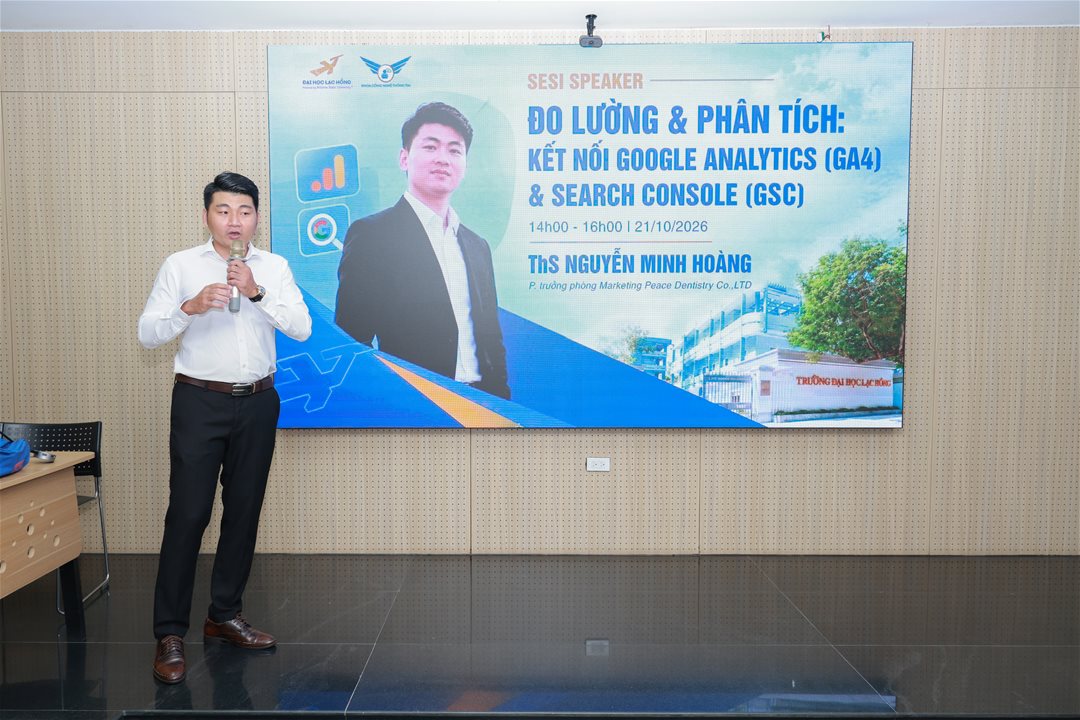
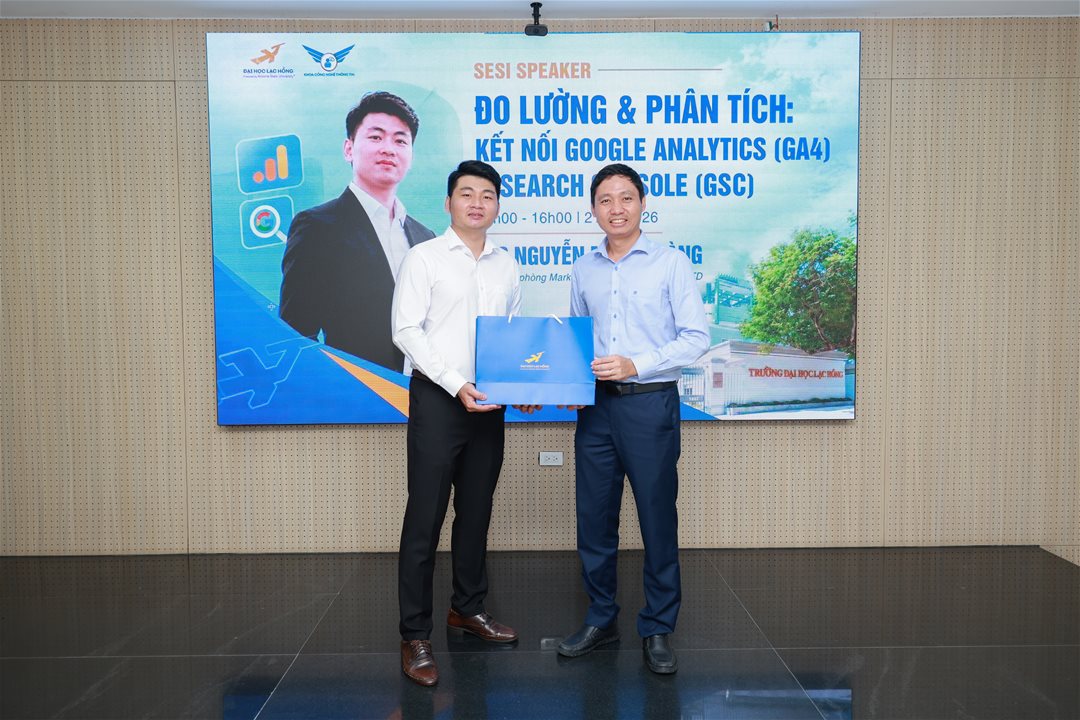
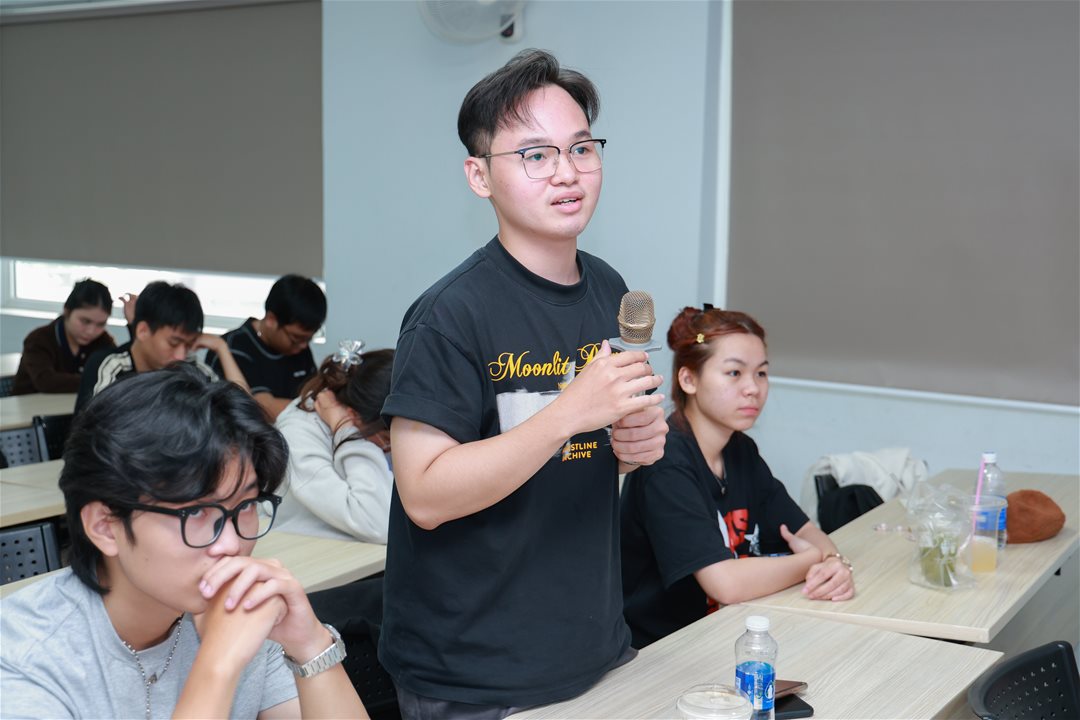
On October 21, 2026, the Faculty of Information Technology at Lac Hong University hosted the SESI Speaker program themed "Measurement & Analytics: Integrating Google Analytics (GA4) & Search Console (GSC)," featuring insights from Mr. Nguyễn Minh Hoàng, Deputy Head of Marketing at Peace Dentistry Co., LTD. The program provided a practical perspective on measuring, analyzing, and optimizing website performance while helping students understand the vital role of data in SEO, digital marketing, and online platform development.
Learning SEO Extends Beyond Ranking on Google
Is the website appearing on Google? What keywords do users search for to find the site? Does the web page attract traffic? Do users genuinely interact with the content after visiting? These are critical questions that SEO practitioners and marketers must answer during website development. However, relying solely on keyword rankings or traffic counts is insufficient to accurately evaluate effectiveness. Professionals must know how to gather data, interpret metrics, and identify areas requiring improvement.
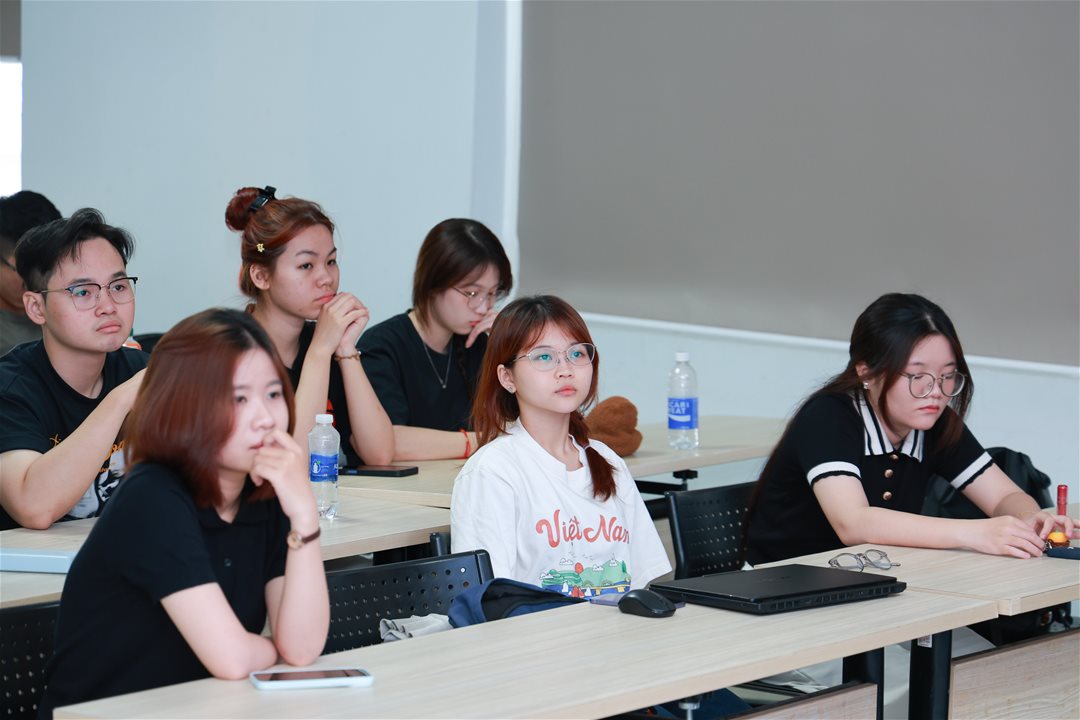
Amid digital transformation, data serves as a fundamental basis for enterprises to evaluate online operational performance and make informed decisions. Consequently, alongside content creation and keyword optimization skills, students must cultivate data analytics thinking and performance measurement based on specific metrics. This formed the core focus of the SESI Speaker program, equipping students with practical approaches to applying web analytics tools within a corporate environment.

Google Analytics 4 and Google Search Console: Two Essential Tools for Website Analysis
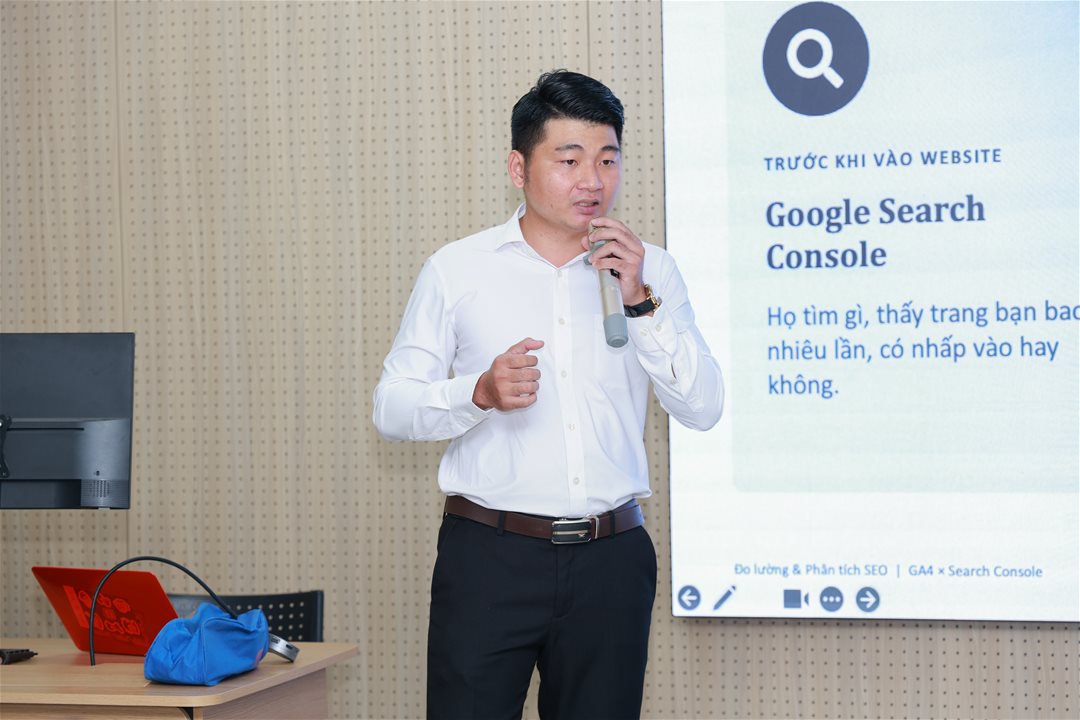
Google Analytics 4 (GA4) and Google Search Console (GSC) are two complementary tools designed to monitor different aspects of website development. Google Analytics 4 (GA4) collects and analyzes data regarding user behavior on websites or applications. Through its reports, marketers can examine traffic sources, engagement levels, tracked events, and marketing campaign performance. Meanwhile, Google Search Console (GSC) provides data on website performance in Google Search, including clicks, impressions, click-through rates (CTR), average positions, and page indexing status.
When used in tandem, these tools provide SEO practitioners with a holistic view of the user journey—from a website's visibility in search results to post-click user behavior. For instance, if a web page generates high impressions but low click-through rates, SEO professionals may need to evaluate whether the title and meta description align with user search intent. If a website attracts traffic but engagement falls short of expectations, GA4 data enables deeper behavioral analysis to identify content or user experience issues. Interpreting data correctly and selecting appropriate metrics provides a solid foundation for website optimization rather than relying on intuition.
From SEO to Media Automation Using N8N
Measuring website performance is an integral part of modern SEO workflows. As the volume of data and platforms grows, manual report generation, metric tracking, and information updates can consume significant time. At the Faculty of Information Technology, Lac Hong University, SEO concepts are interconnected with automation thinking through student learning activities. Previously, LHU students explored digital automation using N8N, learning how to build workflows that connect various tools, organize data pipelines, and streamline repetitive tasks in digital communication.
N8N enables the design of automated processes across multiple applications and services. In the context of SEO, these workflows can support data collection, report synthesis, automated notifications, or data integration with relevant analytics tools. By combining automation mindsets with GA4 and GSC, students visualize how to build more efficient workflows: data is gathered from appropriate sources, results are synthesized according to predefined criteria, and insights are utilized to support analysis and optimization recommendations. The key objective is not merely mastering a specific tool, but understanding how system components collaborate to solve real-world problems.
Bridging Information Technology and Multimedia Communications
In the digital landscape, technology and communications are increasingly intertwined. An effective website requires stable technical architecture alongside compelling content, optimal user experience, and data-driven audience engagement strategies. This intersection defines the synergy between Information Technology and Multimedia Communications at LHU. As highlighted in the article on LHU's Multimedia Communications program—covering academic scope, career paths, and opportunities in the digital creative era—the curriculum bridges content creation with technology, digital marketing, and modern communication trends, including SEO, online advertising, artificial intelligence, and media data analytics.
Beyond specialized knowledge, students access professional environments through experiential activities. A notable example is the program where over 100 LHU Multimedia Communications students learned "Doing Journalism with Tuoi Tre," allowing learners to experience content production workflows and practice media skills within a professional setting. These practical experiences reinforce website analytics competencies, as digital content must not only be created and published but also evaluated for effectiveness after reaching the public.
AI and Data: Essential Competencies for Digital Media Professionals
The advancement of artificial intelligence is reshaping how enterprises build websites, produce content, and execute marketing campaigns. While AI tools streamline various production stages, evaluating content quality, verifying information, and making strategic decisions still require human critical thinking and analytical capability.
Reflecting perspectives from a Pmedia CEO and LHU alumnus, communication careers within rapidly evolving technological contexts underscore the paramount importance of professional competence, adaptability, and personal branding. Combining AI with measurement tools like GA4 and GSC grants media professionals enhanced resources to analyze content performance, understand user needs, and identify improvement directions. Nevertheless, data must be interpreted within proper contexts, and AI-generated recommendations require rigorous validation before implementation.
Consequently, professional capability in the digital era relies not just on utilizing numerous tools, but on the ability to define problems, select appropriate data, evaluate results, and make evidence-based decisions.
Scientific Research and the Foundation of SEO Thinking
Alongside academic coursework and corporate experiences, scientific research plays a crucial role in cultivating problem-solving mindsets among students. Within the student scientific research portfolio of the Faculty of Information Technology, projects dating back to 2017 have explored website optimization workflows on Google and SEO implementation processes for e-commerce websites.
These projects demonstrate that search engine optimization has long been approached from both research and application perspectives within student learning. Over time, alongside the evolution of search technology and AI, SEO challenges have expanded beyond keyword optimization to encompass content quality, visibility, user experience, and data analytics. Integrating SEO foundations with tools like GA4, GSC, and N8N empowers students to develop high-utility projects—ranging from website performance analysis to building data tracking and reporting pipelines.
SESI Speaker: Connecting Experts, Knowledge, and Professional Practice
The SESI Speaker program on website measurement and analytics delivered practical insights into the role of data in SEO and digital marketing. Through expert presentations from industry leaders, students gained a clearer understanding of how analytics tools are deployed in practice while identifying essential skills required for professional workplaces.
From Google Analytics 4 and Google Search Console to N8N and AI applications, these concepts integrate into a cohesive professional workflow: data collection, result analysis, problem identification, solution proposition, and performance evaluation. This pedagogical approach helps Information Technology and Multimedia Communications students gain a deeper understanding of the digital ecosystem, where engineering, content, data, and creative thinking converge.
Through expert and enterprise connectivity initiatives, the Faculty of Information Technology at Lac Hong University continuously empowers students to expand their knowledge, stay abreast of technological trends, and elevate their professional capabilities in the digital era.
The Faculty of Information Technology at Lac Hong University extends its sincere gratitude to Mr. Nguyễn Minh Hoàng, Deputy Head of Marketing at Peace Dentistry Co., LTD, for generously sharing his professional expertise and practical experience in website measurement and analytics via Google Analytics 4 (GA4) and Google Search Console (GSC). The practical insights shared by the expert not only clarified the application of data in SEO and digital marketing but also bridged academic learning with corporate realities, inspiring students to proactively learn, elevate their professional proficiency, and readily adapt to the labor market in the digital age.